Apparel calendar
Why Most D2C Apparel Brands Miss Demand in India, and the 2026 Calendar That Fixes It
A decision map for January to June 2026: what to prepare, what to ship on-site and what to watch, event by event.
By Helium · Published · 10 min read
Short answer. Indian apparel demand in the first half of 2026 peaks around national sale windows (New Year, Republic Day, Valentine's week, End-of-Season Sales), regional festivals (Pongal, Ugadi, Baisakhi, Vishu, Bihu), Eid and the IPL season. Brands miss demand when they start late; this calendar sets prep for each event at T-15, T-10 or T-7 days out.
Most D2C calendars are just dates. This one is a decision map: what to prepare, what to ship on-site, and what to watch in data. It covers 12 national demand windows plus the key regional peaks across North, South, East, West and Central India.
We turned the key demand windows in this guide into a calendar you can add directly to Google Calendar, Apple Calendar or Outlook.
Each entry includes:
- the event or demand window
- when prep should realistically start (T-15 / T-10 / T-7)
- what kind of spike to expect (national, regional or cultural)
- why it matters for apparel specifically
That way, planning doesn't live in a Notion doc you never open. It shows up where decisions actually happen.
How to add it
- Click the calendar link below
- Import it once
- Let the reminders do the work all year
Add the India Apparel Demand Calendar (Jan–Jun 2026) to your calendar
January to June 2026 at a glance
| Date (2026) | Event or window | Start prep |
|---|---|---|
| Jan 1 | New Year's Day | T-15: right after Christmas |
| Jan 13–15 | Lohri, Makar Sankranti & Pongal (regional: North, West, South) | T-15 |
| Jan 26 | Republic Day (national) | T-15, teasers from T-7 |
| Feb 7–14 | Valentine's week | T-15: late January |
| Late Feb | Start of Ramadan prep (Ramadan expected around Feb 18–19) | Late February |
| Mar 4 | Holi | T-15: mid-February |
| Mar 19 | Ugadi & Gudi Padwa (regional: South & West) | T-10 |
| March–April | Ramadan & Eid-ul-Fitr | T-30 (mid-February), Eid push at T-10 |
| March–May | IPL season, playoffs and final in the last week of May | T-15: around Mar 11 |
| Apr 13–15 | Regional New Years: Baisakhi, Pohela Boishakh, Vishu, Puthandu, Bihu (regional: East, South, North) | T-10 |
| May 10 | Mother's Day | T-10 |
| Late June | End-of-Season Sales (EOSS) | T-7 |
| Jun 21 | Father's Day | Same approach as Mother's Day |
January 2026
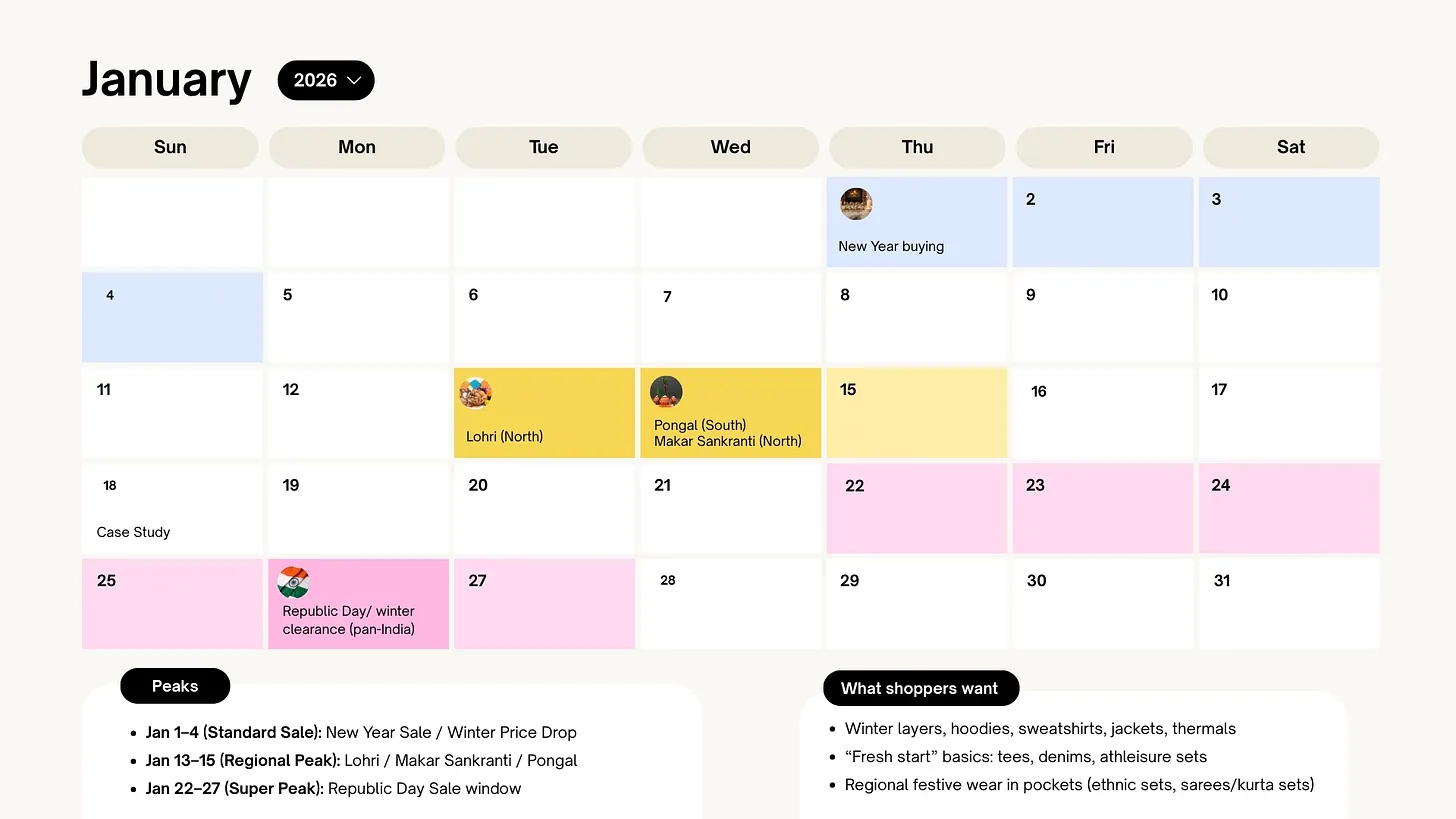
New Year's Day (Jan 1, 2026)
Kicks off the year's first sales. Many fashion brands run New Year sales to clear end-of-year inventory.
- T-15: Launch New Year promotions right after Christmas. Emphasize "New Year, New You" themes for personal care and fashion (e.g. activewear, winter fashion).
- Trends: Shoppers look for apparel deals in the post-Christmas window, and tapping into New Year's resolutions is a natural social media hook for D2C brands.
Lohri, Makar Sankranti & Pongal (Jan 13–15, 2026): Regional (North, West, South)
These drive regional consumption spikes (clothing, sweets) but are not pan-India sale events.
- T-15: Localize marketing for the relevant regions. For example, promote traditional attire (phulkari dupattas for Lohri, sarees for Pongal) in those states. Start communication around the new year's first harvest vibe.
- Trends: Expect a regional uptick in apparel demand around Lohri, Sankranti and Pongal in local markets. Brands that tap regional festivals can get an early-year revenue boost.
Republic Day (Jan 26, 2026): National
While a patriotic holiday, it has evolved into a major e-commerce sale period ("Republic Day Sales") in late January.
- T-15: Announce Republic Day sale dates by early January. Coordinate with marketplaces (Amazon, Flipkart) if you're participating in their R-Day events. Finalize your discount strategy taking cues from prior Big Billion Days and Diwali performance (many brands use R-Day to offload leftover festive stock).
- T-7: Launch teasers highlighting patriotic themes (tricolour merchandise, "Made in India" collections). Begin your paid ad push, and check your own order-time data: if shoppers are buying earlier in the day, adjust ad scheduling accordingly.
- Trends: Tier-II and III cities drive a large share of R-Day online orders, reflecting the broader trend of Bharat shopping more. R-Day sales now mark a strong start to the year's revenue.
February 2026
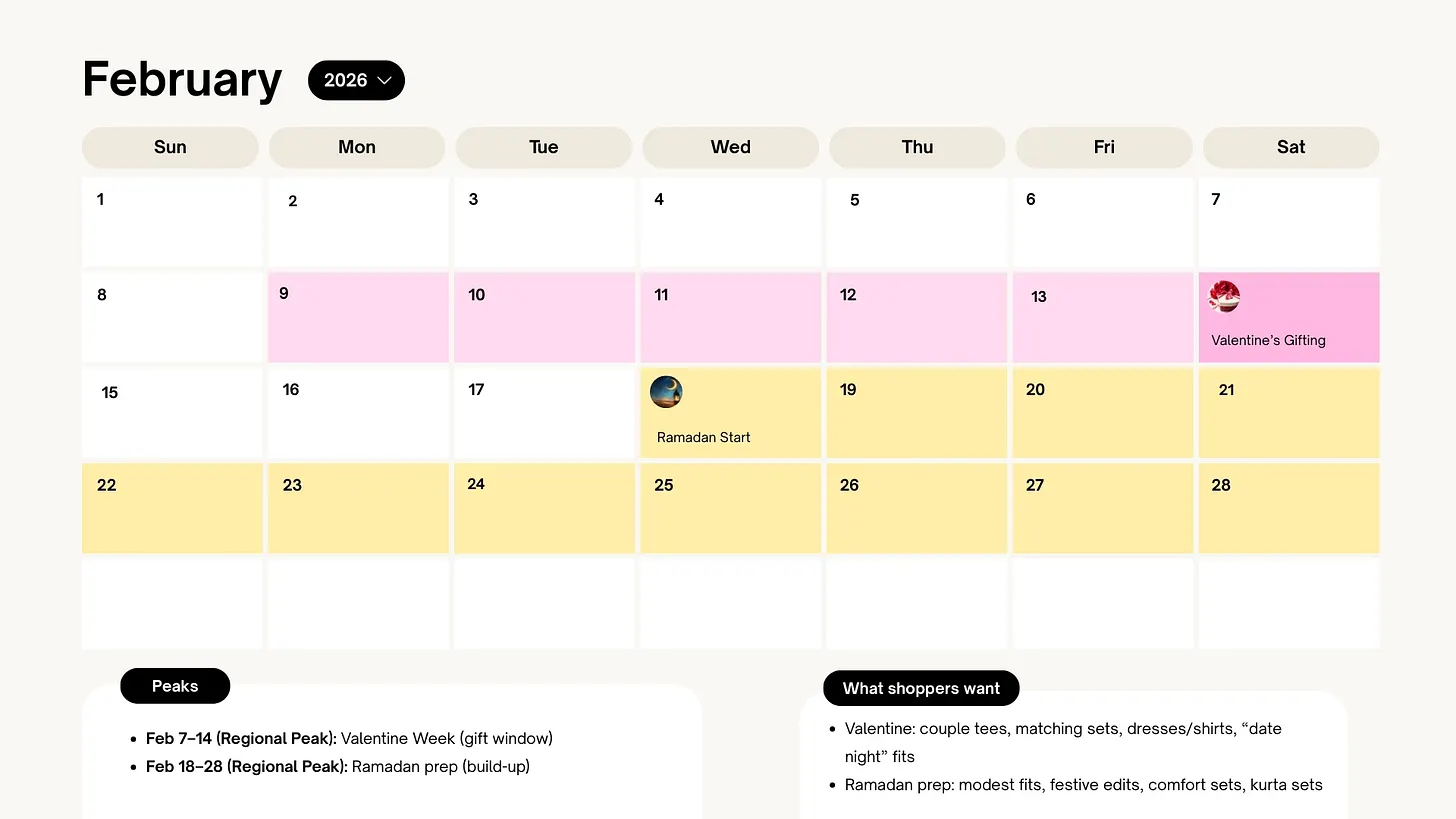
Valentine's Day (Feb 14, 2026)
A major gifting moment in Indian retail. Valentine's week (Feb 7–14) drives spikes in categories like apparel, cakes, soft toys, jewelry and personalized gifts.
- T-15: Roll out Valentine's-specific collections in late January. This is prime time for bundle offers (e.g. "couple kits" combining apparel and accessories, his-and-her gift sets in beauty). Start content marketing on social media, like relationship stories and gift guides, to reach early planners. You can also refer to the Valentine's Day Playbook for D2C Brands.
- T-7: Begin intensive promotions in the first week of February. Highlight order deadlines for delivery by Feb 14.
- Run targeted ads on Meta and Google, especially since young consumers (Gen Z, millennials) account for a big chunk of Valentine's spend and are highly active online.
- Pre-write the "gift missed?" recovery message for Feb 15–17.
- Trends: Personalized shopping experiences (custom messages, curated gift kits) tend to drive engagement, and beauty and fashion D2C brands often run Valentine flash sales in the week leading up to Feb 14.
- Meta and Google ad costs can rise as competition intensifies, so allocate budget carefully for this week and focus on high-converting demographics.
Start of Ramadan prep (late Feb 2026)
Ramadan is expected to begin around Feb 18–19, 2026. While most Ramadan and Eid shopping will happen in March, late February is when consumers start preparing. Brands should begin campaigns now (see March for the detailed Ramadan and Eid strategy).
March 2026
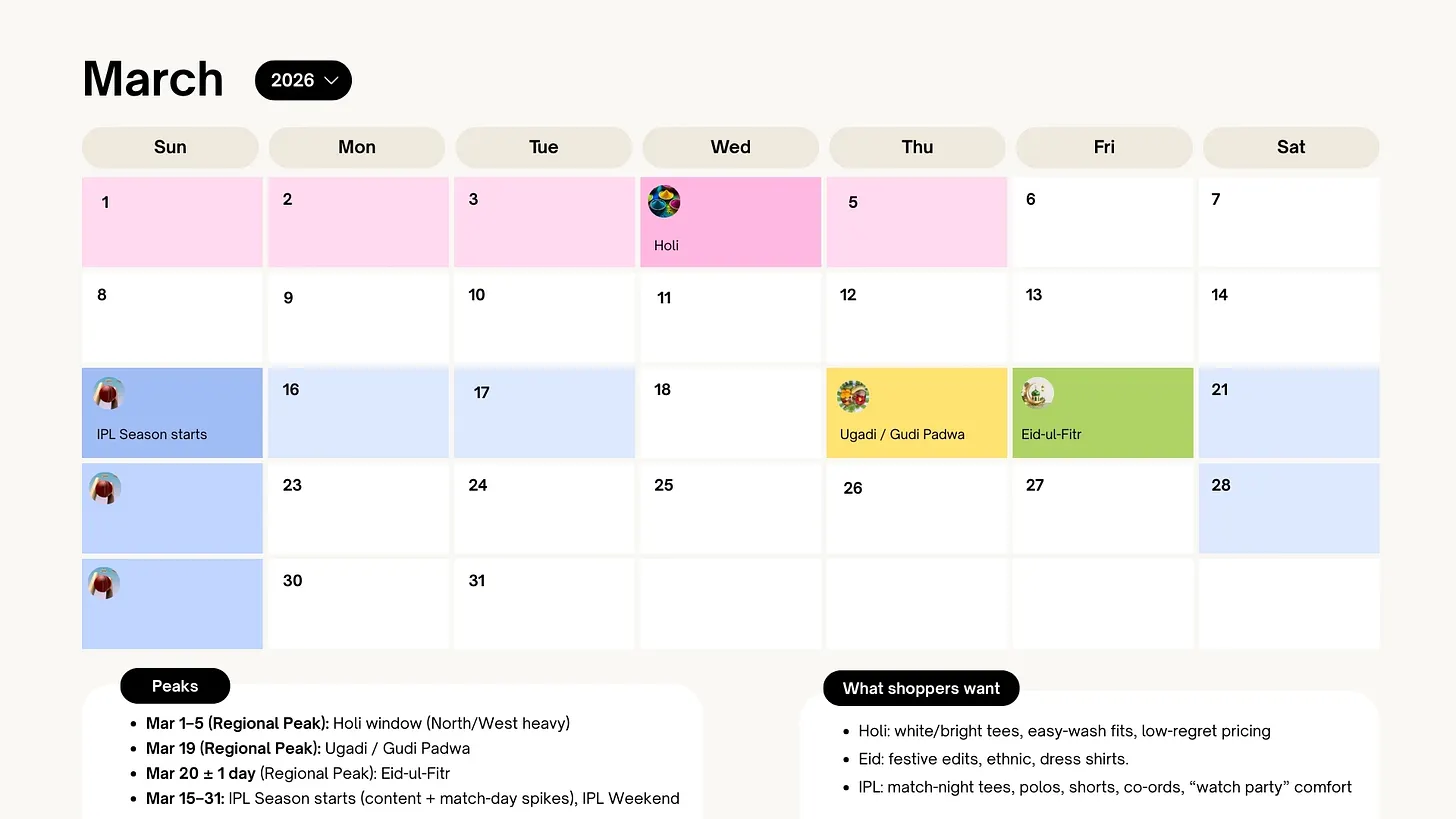
Holi (March 4, 2026)
Holi has become a fun marketing moment. Key categories are white garments (to wear and ruin with colors), skincare (pre- and post-Holi skin and hair protection) and snacks and beverages.
- T-15: Plan Holi campaigns from mid-February. Tease new product lines like "Holi fashion" lookbooks.
- Collaborate with influencers for pre-Holi content (e.g. a YouTuber doing a "Holi look" using your white shirt and waterproof makeup).
- T-7: Ramp up content on social media. Holi is highly visual, so run UGC contests (fans share colorful Holi photos using your products). This is more of a brand-building, storytelling opportunity than a deep-discount sale.
- Trends: Engagement often spikes around Holi because the content is so shareable. For a D2C brand, a successful Holi campaign might be measured in brand reach and community growth rather than pure sales.
Ugadi & Gudi Padwa (March 19, 2026): Regional (South & West)
New Year celebrations in states like Andhra Pradesh and Karnataka (Ugadi) and Maharashtra (Gudi Padwa), along with other regional new years around this date (e.g. Cheti Chand for the Sindhi community).
- T-10: Target regional audiences with tailored messaging ("Celebrate Ugadi in style with our new saree collection!").
- Launch any region-specific products (e.g. a special line of Kanjivaram sarees, or festive wear for Gudi Padwa).
- Trends: You might run a small sale (say, 10% off) labeled as a "New Year Blessing", which respects the spirit without looking like a gimmick. Make sure ethnic wear stock is ready for these regions.
Ramadan & Eid-ul-Fitr (March–April 2026)
In the week before Eid, shopping surges, especially for new clothes (ethnic fashion) and gifts.
- T-30 (mid-Feb): Begin Ramadan-friendly marketing early. For fashion, this is the time to launch modest fashion lines or Eid collection previews, since many consumers start looking early for the perfect Eid outfit.
- T-10 (Eid sales): In the final 10 days (especially the last week of Ramadan), ramp up Eid sale campaigns. This period is like a mini festive season. Offer bundle deals for gifting. Show "arrives by Eid" on key SKUs.
- Trends: In India, e-commerce platforms note that order volumes in categories like apparel and home décor rise sharply just before Eid, especially from states like Uttar Pradesh, West Bengal and Kerala.
- Quick commerce is also becoming a channel for festive purchases, so check how your delivery promise compares.
IPL season starts
IPL behaves like a two-month "live culture" loop. Apparel demand shows up as match-night outfit buying (tees, polos, co-ords, athleisure), summer comfort basics and "watch party" fits. It's also a content engine that can feed your paid and organic every week.
- T-15 (around Mar 11): Pick 3–5 IPL-friendly capsules (e.g. "match-night tees", "summer co-ords", "athleisure sets", "polo + shorts", "oversized basics"). Make these easy to browse from the home and collection pages.
- City routing: Decide your top 8–10 cities to push harder (where franchise fandom is strongest for you). Prep city-based landing pages, or at least city-based ad sets.
- T-7: Seed creators with "match-night fit check" prompts. Ask for 7–10 second clips, not long videos. Announce small weekly drops instead of one big sale. People come back when there's something new.
April 2026
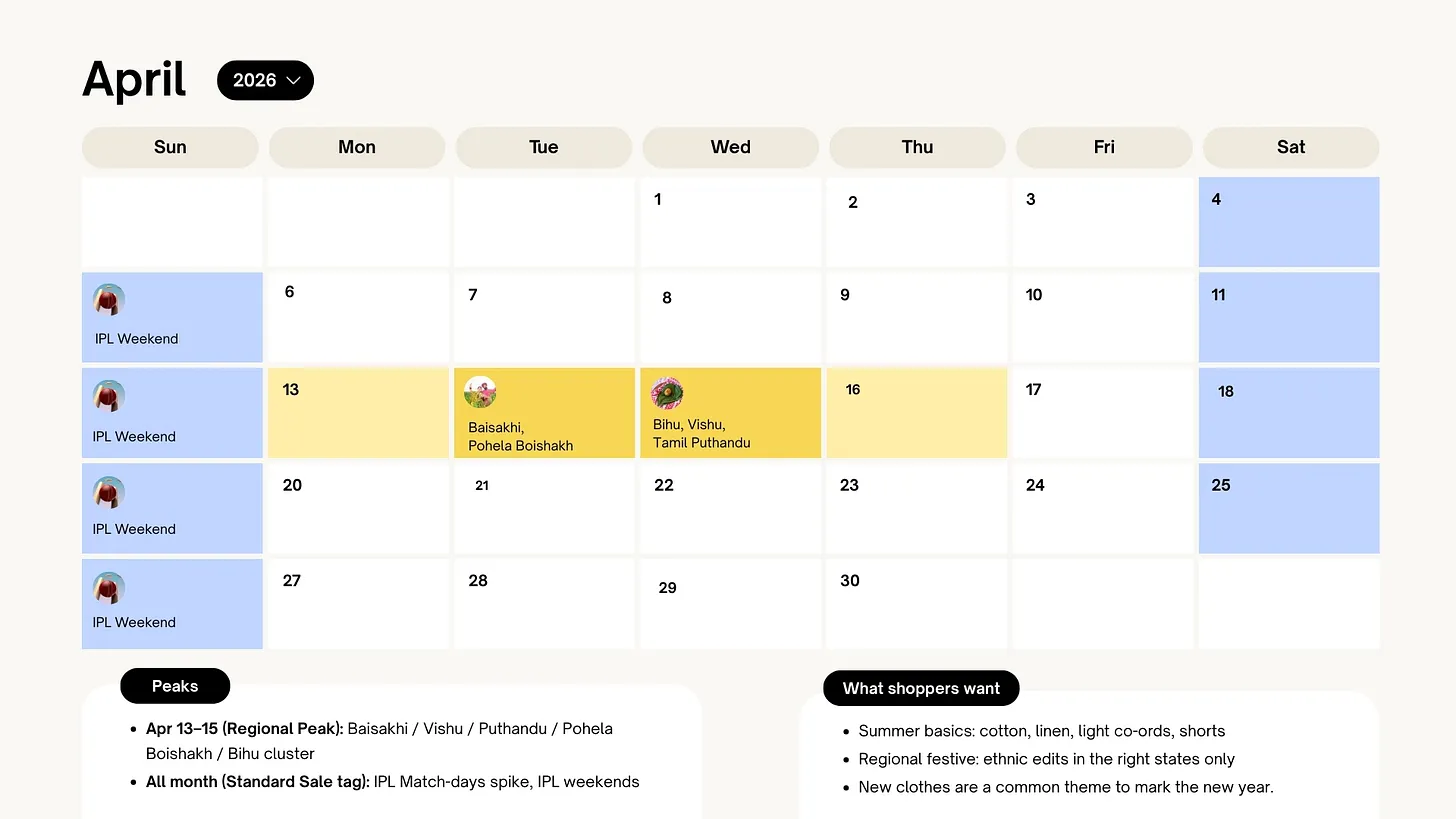
Regional New Years (April 13–15, 2026): Regional (East, South, North)
A cluster of new year festivals: Baisakhi (Punjab, April 14), Pohela Boishakh (Bengali New Year, April 14), Vishu (Kerala, April 15), Tamil Puthandu (April 14) and Bihu (Assam, April 15). This period sees significant regional shopping, and new clothes are a common way to mark the new year.
- T-10: Start region-specific outreach. For example, push Punjabi apparel for Baisakhi in Punjab, showcase Kerala kasavu sarees for Vishu, and promote Assamese mekhela sador for Bihu. Localize ads in regional languages where possible.
- Trends: Regional new years are seeing greater participation in e-commerce as internet access spreads.
IPL match-day spikes
- Expect higher intent in the evenings. Use countdown-style on-site banners on match days.
- Sundays are non-negotiable: Mark every Sunday as Sunday Pulse and plan your Monday ops accordingly (warehouse and support).
- City-first merchandising: Rotate the home-page hero based on top city traffic that week (even without IPL rights, city color packs work).
- Retargeting: Build three pools: (1) video viewers, (2) "capsule" page visitors, (3) cart starters. Run separate creative for each; don't mix.
End of April
This is a relatively quiet period. It's a good time to experiment with off-season sales (the next major spike is a few weeks away in May) or to plan for upcoming events like Mother's Day and summer sales.
May 2026
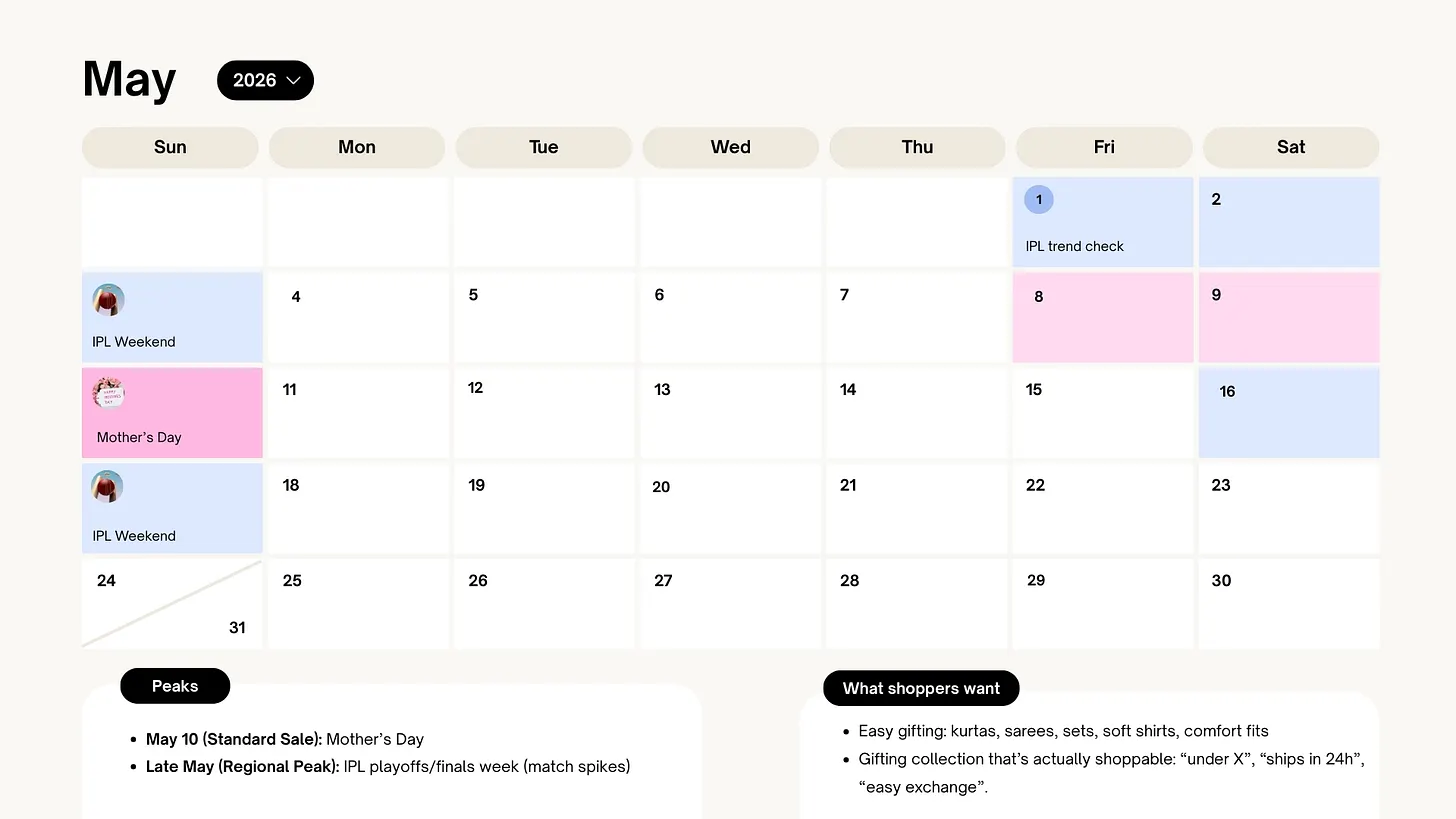
Mother's Day (May 10, 2026)
Not a traditional holiday, but now widely observed in India's cities. It drives gifting in categories like apparel and beauty, as consumers look for thoughtful gifts.
- T-10: Launch a Mother's Day gift guide on your blog or social.
- Build a gifting collection that's actually shoppable: "under X", "ships in 24h", "easy exchange".
- Add bundle logic: kurta + dupatta, shirt + trouser, etc.
- Trends: Since it's not a festival as such, it doesn't need heavy discounting. Customers are motivated by emotion.
IPL playoffs + final week (last week of May)
- Heatmap marking: Set the Regional Peak shade for the playoffs window and the final weekend.
- Bundles: Push two-item bundles (tee + shorts, co-ord set, polo + cap) to lift AOV without deep cuts.
- Stock discipline: Don't carry too many variants. Winners sell fast in peaks; losers kill your cash.
June 2026
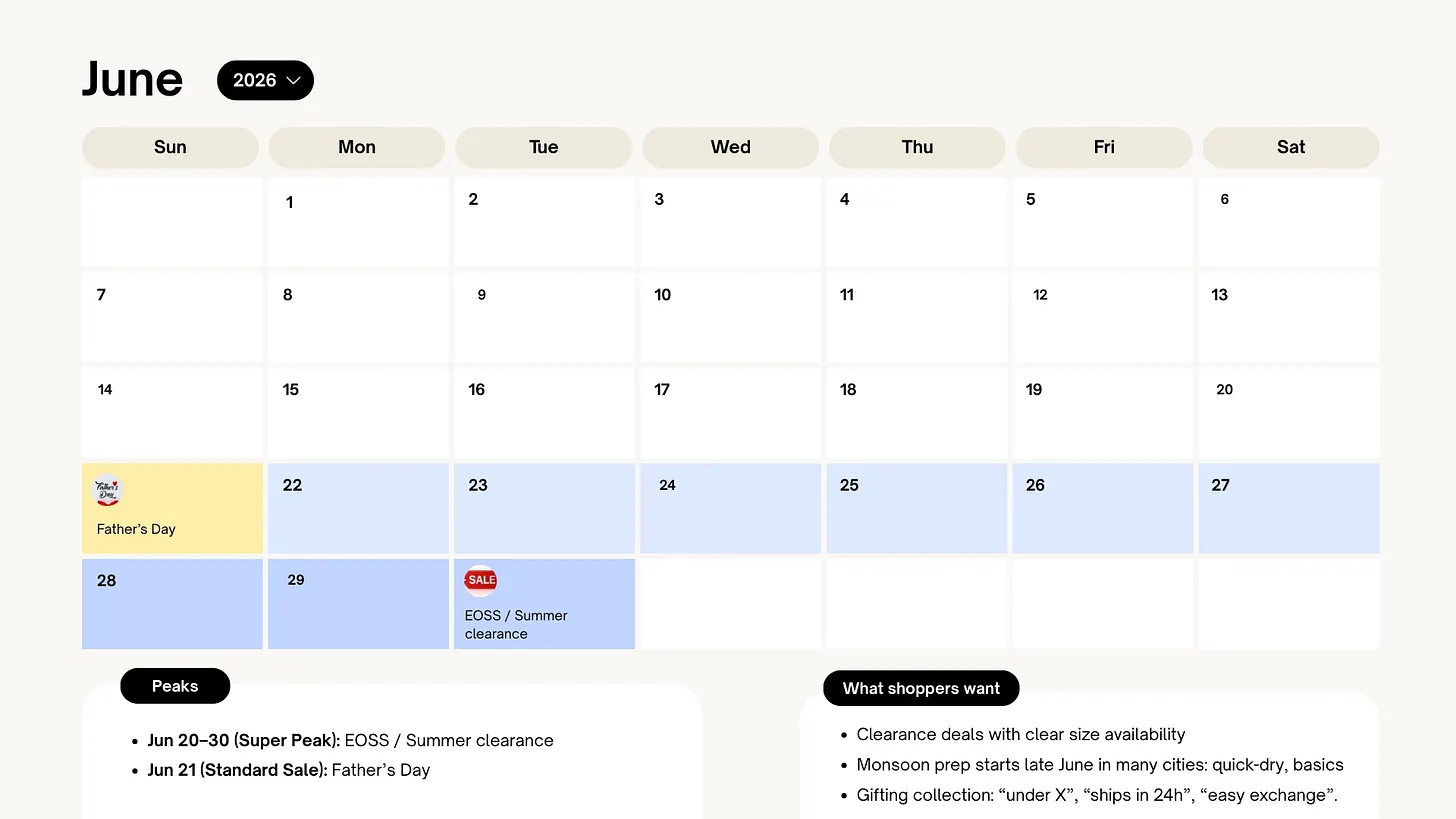
End-of-Season Sales (EOSS)
Most fashion brands run big clearance sales in late June or early July to make way for new-season inventory. Marketplaces run summer sales in this period (Flipkart Big Saving Days, Amazon's June sales, etc.). For D2C, this is a chance to boost Q2 sales and clear stock.
- T-7: Announce your EOSS dates and "sneak peeks" of discounts. This is a pure sale play, so a time-boxed offer fits (e.g. "72 hours only, up to 50% off").
- Use email campaigns to target existing customers (clearance is a good way to win back lapsed buyers with low prices).
- Use site-wide banners, affiliate marketing and push notifications to drive traffic during the sale window.
- New customers often try brands during clearance (low risk at a low price). Use this to fuel acquisition, then nurture them into repeat buyers with new arrivals later.
Father's Day (June 21, 2026)
Mirrors Mother's Day, usually with a bit less fanfare in India.
- Take a similar approach to Mother's Day, with "For Dad" gift guides. Storytelling can revolve around appreciating fathers (#HeroWithoutCape-type sentiments). Many fashion brands release "Dad and me" matching apparel around this time.
By planning timelines (starting 15+ days out where needed), tailoring campaigns to each event's sentiment, managing inventory and logistics proactively, and learning from 2025's trends (earlier shopping, higher reliance on digital and the rise of Tier-2 and Tier-3 consumers), brands can ride the wave of demand through the year.
Keep reading
Related.
How Meta itself changes through the year in India
Meta moves through four operating states in India each year. Plan budget, creative and measurement for the state you are in.

Quality-Weighted Retargeting: The Playbook for Higher ROAS This Festive Season
Retarget shoppers who hit a specific, fixable blocker. Suppress the browsers, and keep spending after December 25.
Valentine’s Day 2026: how Indian D2C brands can make shoppers spend more
Discounts buy volume and cost margin. Bigger Valentine's carts come from making gifting feel low-effort and certain.
Helium for Shopify
Every regional peak, merchandised.
Helium ranks your Shopify collections by city, persona and sales, so a Pongal or Bihu shopper sees the right edit first.
Rather talk? or WhatsApp us